ROMEO5 Air
A traffic picture for aerodromes that never had one.
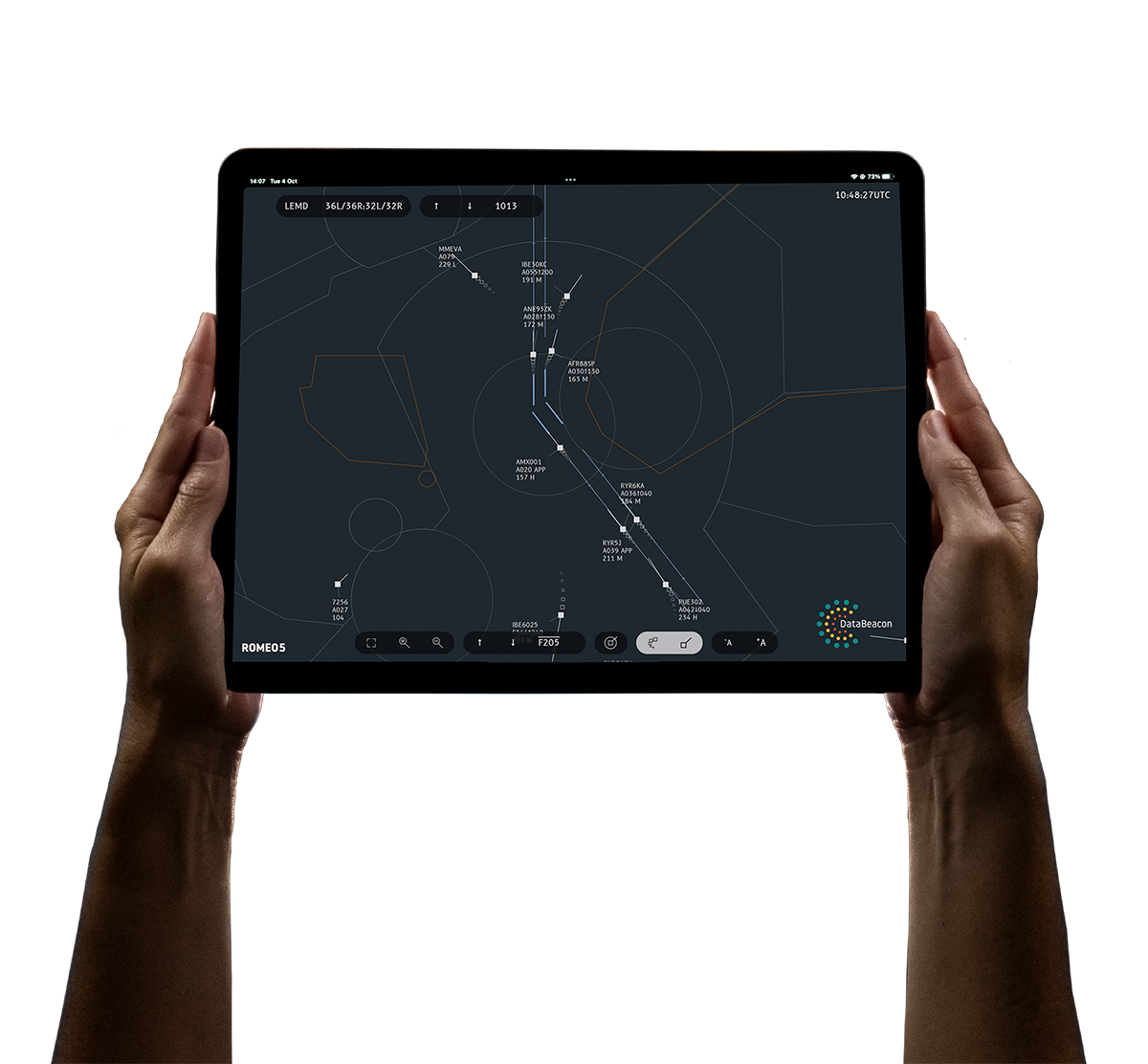
ROMEO5 Air is a Flight Information Display for the visual control room. It builds the air picture from ADS-B and Mode-S reception rather than radar, so an aerodrome without surveillance stops working from radio calls and out-of-the-window observation alone.
The display
Always know how each flight is developing.
ROMEO5 Air tracks how each flight is evolving and refreshes once a second, so the operator stays in control of the picture and knows what is going on. If a target stops updating, the display makes that obvious rather than quietly showing stale data.
- Label shows callsign, level with climb/descent arrow, squawk and ground speed
- Emergency squawks turn the target, label and trail red with a three-letter code
- Labels de-conflict themselves automatically, with leader lines back to each target
- 30-second speed vector and a 35-second historical trail
Designed to the standards
Built against the requirements you are regulated by.
A tower display is only useful if it can survive the scrutiny that comes with putting it in an operational room. ROMEO5 Air is designed against published requirements rather than to a house style.
- Target dropout behaviour follows the UK CAA's CAP670 requirements
- Altimetry and transition-level handling follow the published altimeter setting procedures
- Delivered with configuration-controlled documentation — user manual, installation and maintenance manual, amendment record, and a manual-to-software version compatibility record
DataBeacon does not provide approval services. We supply the compliance evidence needed to support your safety case; the safety case and the approval remain with the air navigation service provider.
ROMEO5 Air is a situational-awareness aid. The controlled user manual states that it shall not be used for the provision of air traffic surveillance services.
Altimetry
Set the QNH; the display works out the rest.
The operator sets QNH in 1 hPa steps with an explicit accept step. ROMEO5 Air corrects displayed altitudes and computes the transition level itself, following UK AIP ENR 1.7 §3.3 — altitude below the transition altitude, flight level above the transition level, handled correctly in both directions through the transition layer.
If the QNH setting goes stale, the display drops the altitude marker rather than showing a figure it cannot stand behind.
Built for a tower
Designed around the room it sits in.
Lighting
Day and night, five brightness levels
Map brightness and target/label brightness are controlled independently, so the picture stays readable from full sun to a darkened tower.
Legibility
Text size separate from zoom
Label text can be enlarged without changing the map scale — useful when the display is read from across the room.
Your aerodrome
Cartography built per site
Runway centreline extensions marked every nautical mile from 1 to 10, range rings at 3, 5, 10, 15, 20 and 25 NM, airspace, restricted areas, VRPs and IAP points as selectable layers.
Where it runs
Cloud, or a single box in the equipment room.
The same display runs either way. On-premise, ROMEO5 ships as one self-contained binary with its own web server and map tiles compiled in, so it keeps working with no internet connection at all. In the cloud it adds a multi-site configuration console, sign-in and access to replay and analytics.
| Surveillance in | 1090 MHz ADS-B / Mode-S from GPS-disciplined receivers. The platform also accepts ASTERIX CAT062 radar, UAT 978, FLARM and satellite ADS-B, though a tower display is normally fed from local ADS-B |
|---|---|
| Update rate | 1 Hz under nominal conditions |
| Loss of data | Target frozen and marked FZN at 15 s; removed at 20 s, in line with CAP670 |
| Fault detection | Receiver connection fault within 4 s; system integrity self-check within 1–10 s, with a full-screen red frame and automatic recovery |
| On site | DataBeacon supplies receivers, servers and display clients. The customer provides monitors, cabling, power, a LAN segment with DNS and NTP, and remote support access |
| Display | Minimum 1080 px screen width. Tablets supported; phones are not |
| Vertical filter | Selectable FL010–FL600; everything below FL005 is filtered out to suppress ground vehicles |
Deployments run two physically independent chains — receiver, server and display per chain. In practice the most common obstacle is the customer's own network topology rather than the equipment, so it is worth involving airport IT early.
Look at real traffic, right now.
The demo runs on live Madrid data — the same display, the same one-second refresh.